
Ascale constructed using only the notes found in the harmonic series is called a scale of 'just intonation'. Unfortunately, musical instruments built around such a scale are only able to play music in one or two keys. This is because the intervals produced by the upper partials are not equally spaced within the octave. Some notes therefore sound out of tune when the instrument is used to play in more remote keys.
In practice, no instrument can produce all the notes of the harmonic series. This is so irrespective of the ability of the player. A trumpeter, for example, is not normally expected to play a concert B-flat on the second space of the bass clef. This is, however, the fundamental tone of the instrument in the “open” position (no valves depressed). Another important limitation is - as previously noted - that certain upper partials (the 7th, 11th, 13th, and 14th, for example) are slightly out of tune when compared to the notes of the “equal temperament”. Modern wind instruments attempt to minimize the problem by bringing into play other fundamental tones and their associated partials.
The following illustration shows the harmonic series as it applies to the "open" notes on a modern trumpet:
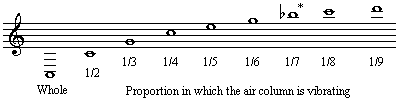
The lowest note (the true fundamental) is not normally used by brass players because it sounds bad and is very difficult to play. The seventh partial (see asterisk in example above) sounds out of tune because it does not fit easily with the system of "equal temperament" now in common use. This is the reason trumpet players are taught to use the first valve instead (thus bringing into play a completely different harmonic series).
Some sort of reasonable balance needs to be struck. An important point to bear in mind is that different manufacturers seek different solutions, some of which may not be entirely satisfactory.


